Recovered dollars
The money already yours, that nobody is asking for.
Three leaks account for most of what a billing operation quietly loses: denials that get written off because working them costs more than they seem worth, coverage that existed but nobody checked for, and checks that come in short with no explanation. NxtPivot works all three, on a schedule, without anyone remembering to.
- Underpayments flagged against your real contracted rates, never estimates
- Short checks decoded and linked to the claim they came from
- Unexplained adjustments flagged, not quietly posted
Three leaks, one engine.
None of these are exotic. They are all the same shape: money that is legitimately owed, losing to the arithmetic of a human minute. Checking is expensive, so checking does not happen, so the money leaves.
Leak one
They paid less than the contract.
Your contract says $250 for a code. The remittance says $220. Nobody notices, because nobody is comparing every line to a contract. We compare every line, flag the $30, and total it by payer, by practice, by month.
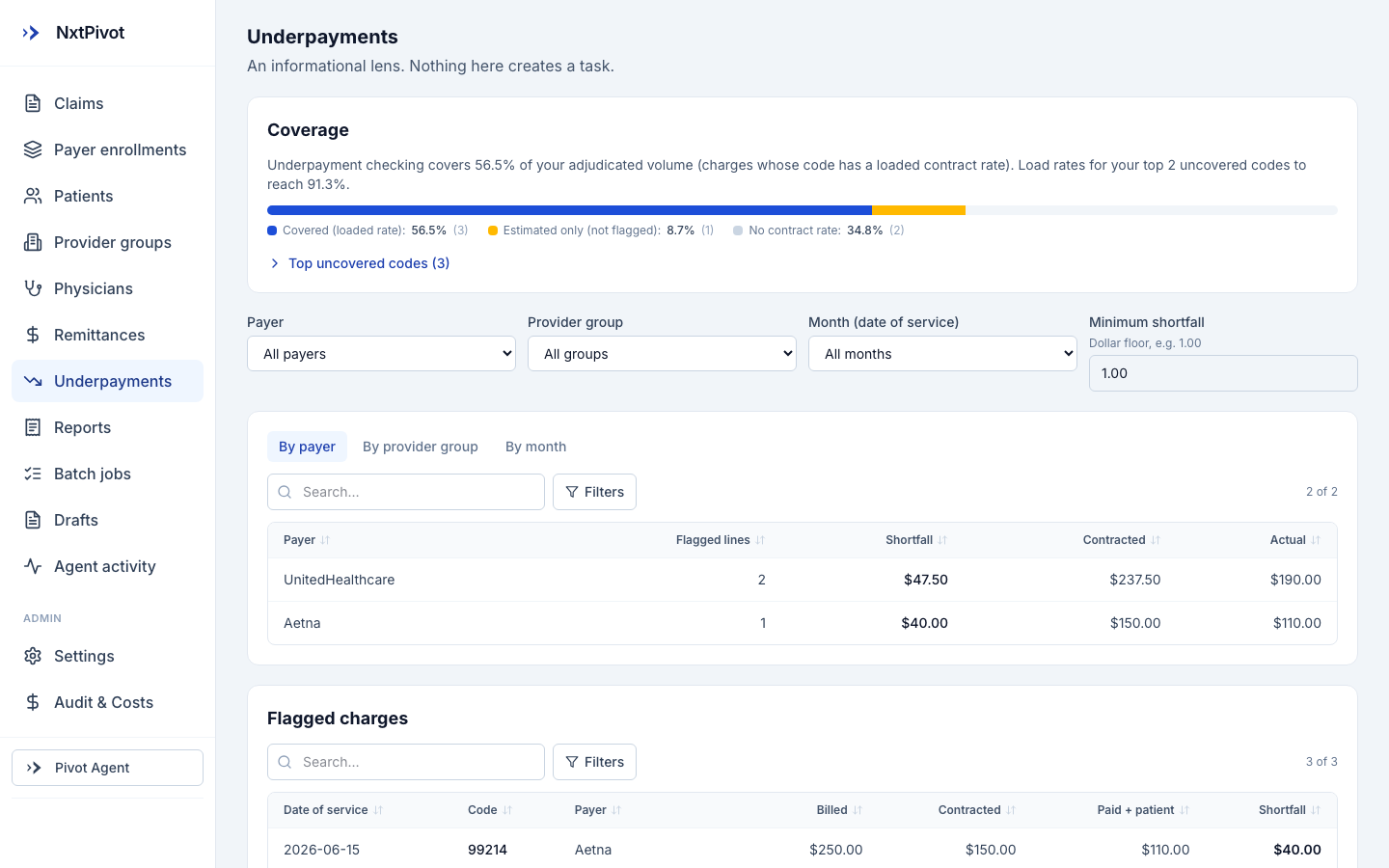
We only flag where your real contracted rate is loaded. The coverage meter shows you how much of your book that actually is.
Leak two
There was coverage all along.
A patient is billed as self-pay, or a claim is denied for eligibility, and that is where it ends. Sometimes coverage was approved afterward and backdated. Sometimes there was a secondary nobody mentioned at intake. Asking that question, for every patient, every month, is exactly what an automation is for.
Patients who come back covered drop off the list, so the same search never gets paid for twice.
Leak three
The check does not add up.
A payment arrives for less than the claims it covers, with no explanation a human can read. Reconciliation is where billers lose hours, and where an unreconciled difference turns into a write-off just to close the month.
We decode each adjustment, link recoupments to the original claim, and flag what we cannot explain rather than hiding it.
Scenario: the check arrives
Payment posting should be a review, not an afternoon of typing.
An electronic remittance turns up carrying a few dozen claims. Each one has an allowed amount, a paid amount, a contractual adjustment, a patient responsibility, and often an adjustment code explaining a piece of it. Posting that by hand is hours of careful, boring, error-prone transcription, and it is how most billing days end.
The work is not hard. It is just long, and the long ones are where the mistakes hide.
- 1
The remittance lands and is parsed
Claim by claim, line by line: what was allowed, what was paid, what was adjusted off, and what falls to the patient.
- 2
Lines post themselves against the charges
Each payment matches to the charge it belongs to, so the patient account, the claim and the ledger all move together instead of separately.
- 3
Adjustment codes are decoded into English
A contractual write-off is recorded as a contractual write-off. A denial reason is recorded as a denial reason, and routes the claim into the denial work rather than closing it.
- 4
The biller reviews the exceptions
The clean majority is already posted. Attention goes to the handful that need a decision, which is where a biller was always worth more than a keyboard.
-
Outcome: the biller reviews the remittance instead of typing it.
And when a check refuses to reconcile, it is never quietly forced to balance. That case gets its own treatment, below.
One remittance, posted
- Claim 3001 · paid
- $400.00
- Claim 3002 · paid
- $350.00
- Claim 3003 · paid
- $250.00
Balanced: the check equals what it paid on claims. Nothing is left for a human to chase.
Scenario: the check does not add up
A remittance we cannot fully explain does not get posted.
Every honest remittance obeys one equation: the check equals what it paid on the claims, minus the adjustments the payer made at the account level. Those account-level adjustments are how a payer claws back an old overpayment, or adds interest, or applies a levy.
When that equation does not hold, there is money on the check nobody has explained yet. The tempting move is to post the claims at face value and let a small difference disappear into a write-off to close the month. That difference is exactly the thing worth looking at.
- 1
The equation is checked on every remittance
Check amount against the sum of claim payments, adjusted for every account-level line. It either reconciles to the cent or it does not.
- 2
Each account-level adjustment is decoded
A recoupment is named as a recoupment and linked to the specific earlier claim it came out of, so the trail lives on that claim permanently. Interest is booked as interest.
- 3
The leftover is stated, with its direction
Not "this does not balance" but "this check is $15.75 more than the claims and the recoupment account for". A surplus and a shortfall are different problems.
- 4
The whole remittance is parked, not posted
It goes to a reconciliation worklist. And any account-level adjustment at all, even one that explains itself perfectly, gets a human's eyes before the money moves.
-
Outcome: $15.75 that would have vanished into a write-off is sitting in a queue with its arithmetic attached.
Small on one check. The point is that it is the same detector that catches the $2,000 recoupment nobody linked to a claim.
Out of balance by $15.75
- Check amount
- $965.75
- Sum of claim payments
- $1,000.00
- Recoupment on an earlier claim linked
- −$50.00
Parked for review. The check carries $15.75 more than the claims and the recoupment explain, so nothing posts until someone says what it is.
Scenario: paid, but not what was agreed
No denial, no adjustment code, no phone call. Just less money.
Your contract says $250 for an established-patient visit. The remittance pays $110 and the claim closes as paid. There is nothing to appeal, nothing flashing red, and no queue it lands in. It looks exactly like a claim that went well.
Catching it means comparing every paid line against the rate you actually negotiated, on every claim, forever. No team does that by hand, so underpayments are usually discovered by accident or not at all.
- 1
Your contracted rates are loaded
Per payer, per code. By hand, from a file, from another group, or by handing the assistant a spreadsheet and letting it do the loading.
- 2
Every paid line is compared
Contracted rate against what actually arrived, including the patient portion, so a shortfall is a real shortfall and not just a balance the patient still owes.
- 3
The shortfall is shown with its arithmetic
Billed, contracted, paid, and the difference, on the line it came from. You can see the $40 rather than being told a total to trust.
- 4
And it tells you what it cannot see
A coverage meter states plainly what share of your volume is actually being checked. Where no contract rate is loaded, nothing is flagged and nothing is estimated.
-
Outcome: the conversation becomes "you underpaid us on 41 visits last month".
Totalled by payer, by practice, by month. That is a negotiation with evidence, instead of an awkward call about one claim.
Denials
The reason denials get written off is arithmetic, not laziness.
A denial takes a person twenty to thirty minutes to investigate properly: read it, check eligibility, verify what was sent, find the rule, decide whether it is worth appealing. At any real volume, a team can only reach the top of that pile. The rest ages, and aged claims become write-offs. That is not a training problem. It is what happens when the cost of looking exceeds the value of most individual claims.
Our engine investigates every denial as it arrives, not the subset somebody had time for. By the time a biller opens the claim, the root cause, the rule it turns on, and a recommended action are already there. The biller reviews and decides. The half hour of digging is the part that is gone.
What we will not claim
- We do not file appeals for you end to end. The investigation and the draft are automated. Filing is yours.
- We do not auto-code claims. Coding is a liability decision that belongs to the practice. We find the money; we do not change what you billed for.
- We do not flag underpayments we cannot prove. No contract rate loaded means no flag, and the coverage meter says so plainly.
Why this matters to the owner
Recovered dollars are the only argument that never needs explaining.
A doctor does not want to hear about your software. She wants to hear that money she had written off came back. Every recovered dollar is attributable to the claim it came from, which means you can show her the list. That is the conversation that keeps a practice from shopping around, and it is the reason this is the first thing we build for.
Questions billers ask
- How do you know a payer underpaid us?
- By comparing what they paid against the contracted rate you loaded for that payer. If we do not have your contract rate for a code, we do not flag it, and we do not estimate one. A coverage meter tells you exactly what share of your volume is actually being checked, so you know how much of the picture you are seeing.
- Our check does not match the claims it covers. Can you explain that?
- Usually yes. Most short checks are a provider-level adjustment: the payer clawing back an overpayment from an earlier claim, or adding interest, or applying a levy. We decode each one in plain English and link a recoupment to the specific claim it came out of, so the trail is on that claim forever.
- What happens to adjustments you cannot explain?
- They get flagged for review. They do not get posted quietly to make the books balance. A remittance that does not add up is surfaced as a remittance that does not add up.
- Does the assistant appeal denials automatically?
- It investigates and drafts. It does not file on its own. A person reviews the root cause, the recommended action, and the draft, then acts. We are being precise here on purpose: end-to-end automatic appeal submission is not something we claim.
- What about the money sitting in old A/R?
- The same engine works it. The reason old A/R gets written off is that investigating each claim is expensive in human minutes, so teams only reach the top of the pile. When investigation runs on every claim rather than the ones somebody had time for, the pile is a review queue instead of a write-off.
See it on a claim you recognize.
Fifteen minutes, screen shared, your workflow. No contract, no data required to start.
Book a walkthrough